
 Nederlands
 English
Category: wiki
Documents… differently
(Dutch column voor ‘digital government’)
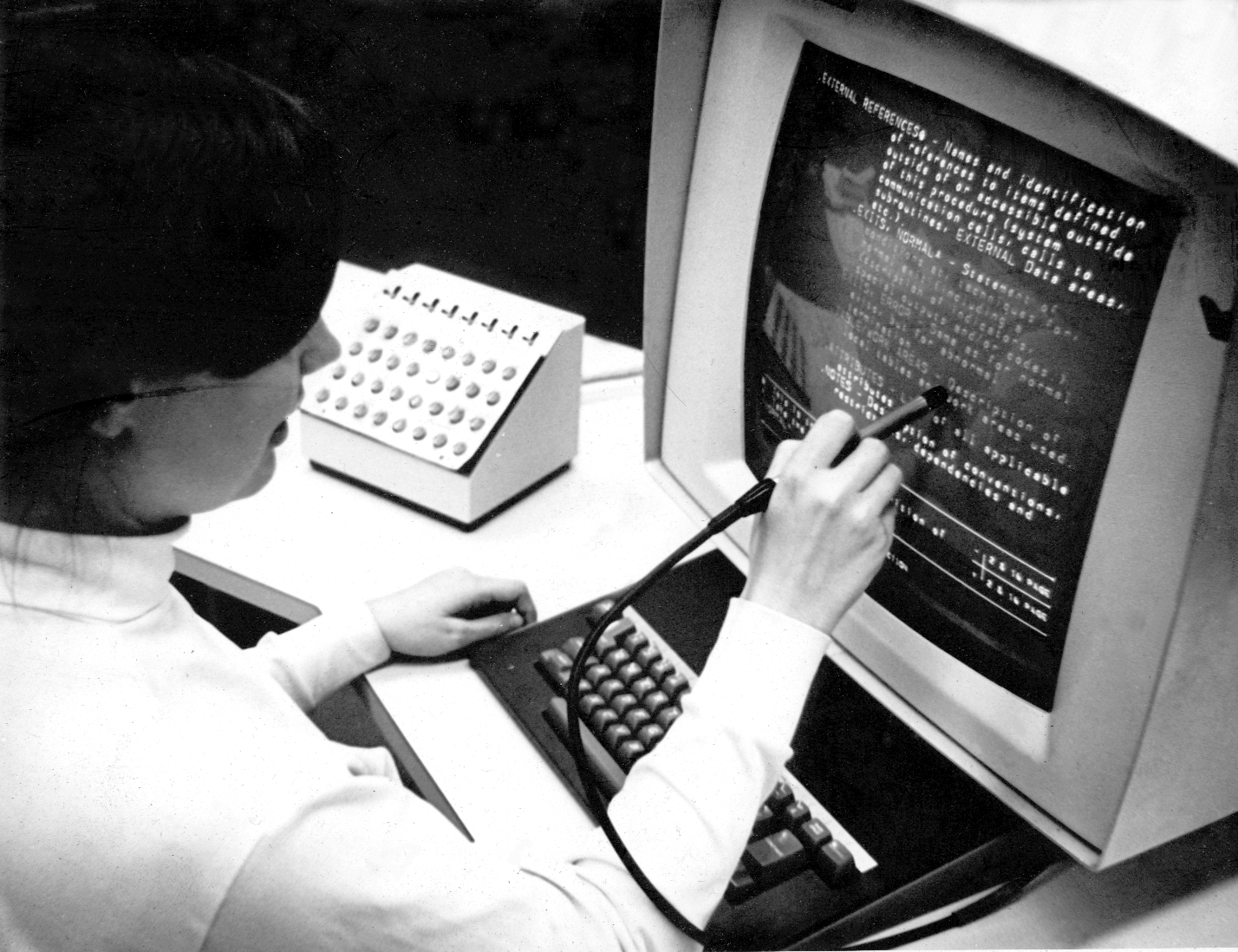 What is a document? It started as a flat piece of beaten clay, onto which characters were scratched with a stick. 8000 years later it was found and after years of study, archaeologists concluded that it said: ‘You owe me three goats”. ??
Through papyrus and parchment scrolls we arrived at mass production of paper and book printing in Europe in the 15th century. Our sense of the nature of a document is still derived from this previous revolution in information capture and distribution. When computers became commonplace as a tool to create documents, there was therefore a strong focus on applications to produce paper document as quickly and nicely as possible. The creation had become digital, but the final result was not fundamentally different from the first printed book in 1452.
Most word processors in use today cling to this concept. There are hundreds of functions for page numbering, footnotes and layout to achieve a legible final result – on paper. Many IT tools around the management and access of documents are directed to the concept of a digital document as a stack of paper. Ready to print for ‘real’ use. The modern ways of working together for various reasons no longer apply to a paper-oriented way of recording and distribution. Paper is static, local, and now much slower and more expensive to transport than bits. It is this combination of restrictions has led to new ways of creating documents where both the creative process and the end result is digital. A famous example is Wikipedia, the world’s largest encyclopaedia with millions of participants continually writing and rewriting about the latest insights in technology, science, history, culture or even the biography of Andre Hazes.??
In this new form a document is a compilation of information at an agreed place online. In Wiki environments anyone can register and then comment or improve the document. This input is visible and therefore usable for all other participants so the end result is the sum of knowledge rather than the interpretations of a small number of "editors". ??
If the future of documents is digital, with a new way of working we also need new tools. Page numbering and footnotes are irrelevant in hypertext. However, what is relevant in a culture of transparency and collaboration is software that allows comfortable "writing" (another old word) in a web browser.
Smarter working
Imagine that all the modern communication tools of today are not be available to you. No mail, no chat, no Twitter, Facebook or phone. Now imagine that you are a company with 50 employees who need to be in daily contact. How do you solve it? With them all working at the same location. Simple puzzle, right?

Now let us turn the question around: all these modern tools are available to you, so why are you going to the office every day? And as a bonus question: are you aware that a hundred years ago we were driving around with a horse and carriage?
Our computers remind us daily of old-fashioned working methods: we neatly arrange our files and folders in our digital filing cabinet every evening before we go home. To share information with colleagues we make a copy of the folder and forward it on. And if we make changes, there are suddenly two versions of the document. Colleagues can also modify the file, and then there are three.
In other words, although the resources we have at our disposal are dramatically improved and allow completely new ways of working, we still work as our grandparents did. Effectively, we are working on more efficient typewriters, but at the end of the day, few companies realise the full potential of the equipment and the people they have invested in.
The future we are anticipating is already here; in fact, many of us use it every day. Wikipedia is famously a prime example of a kind of hive mind, a collective brain that is fed by thousands of people around the world: people who do not know each other, have never spoken, and who are certainly not all congregating every day at 09:00 in an office building.
How that came about is due partly to smart technology and smart people:
- the knowledge is in a central location;
- modern communication tools are used; and
- meritocracy instead of bureaucracy.
The knowledge is in a central location
Instead of emailing versions of a document back and forth until everyone is happy, the document is placed on a wiki at a central location where it is edited. This not only prevents lost editions, but you ensure that everyone can see the latest version. In the case of software this principle is pretty much the same: the software is in a central "repository" and the documentation is online in a maintained and updated wiki. Everyone, from anywhere, can see it.
Modern communication tools are used
Instead of a meeting every Tuesday at 14:00 , people are continuously connected to each other, by mail, through the wiki, via telephone, Skype or Twitter. Time and space are of little importance as long as the flow of information and associated activities are not inhibited.
Meritocracy versus bureaucracy
In many online projects, you see that most people with professional knowledge take decisions in consultation with the rest of the team. "Rough consensus and running code" was once the slogan in the early days of the Internet: as long as we are roughly on the same page with each other and it works, fine.
We love the fact that people can travel easily. Many companies even allow you to take unpaid leave for a few months to go on a world tour – it’s a good way to develop broader horizons. Companies even allow you to take unpaid leave for a few months to go on a world tour – it’s a good way to develop broader horizons.
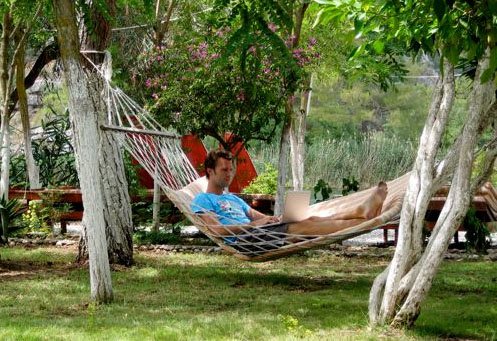 |
| At work in Turkey, including this piece. |
But meanwhile, we continue to force people to work in offices day in, day out, uninspired and with their mental blinkers on. Why? It’s old-fashioned management, which is down to individual management style. I have met managers in their fifties who rally the troops, but also managers in their early thirties who are stuck in a time warp. One of the major concerns of such managers is the fear of losing control of the employee. "How can I see what someone is doing when he is not in the office?"
This is the typical mentality of people stuck in a certain mindset. It implies that when employees are in the office, the manager has the ability to continuously monitor what employees do. This is nonsense. Furthermore, a manager has better things to do than to nanny his staff. In addition, it also ignores the fact that new software tools give the manager more real insight into what the employee does.
At Gendo we work with different people at different locations. I often see my colleagues only two days a week. Yet we are continuously in touch and, via an internal Twitter channel, I can follow what colleagues are doing. We also have a wiki that gives me a great insight into what people are working on – much more than would be possible from ‘walking the floor’ to see if everyone is behind his desk. In other words, colleagues and management gain more, rather than less, insight into the activities of employees who "work smarter". Of course, personal contact is invaluable and we are happy to see each other. But we see each other for a purpose and not because we’re afraid the others are not doing their job.
These new tools also make it possible for the employee to work wherever and whenever they want. This is a problem for managers of the old school, as I have heard time and time again. If I buy a magazine and read it at my desk, I’m at work. If I read the same magazine sitting in the sunshine outside the office, I’m not working. I sit in the sun because that is fun, so it’s not working. This is such an embarrassing reasoning that it’s difficult to believe people actually still credit it. A friend told me that she needed to meet some colleagues, and suggested that they do it outside in the sun. Her colleagues felt that others might think that they were not working. Her proposal: we take a pen and paper with us then, if people see us, at least they will think we are working. It is kindergarten-level thinking and modern professionals in such an environment should make a run for it and escape to an organisation that treats them as adults.
In some companies the concept of ‘work smarter’ is to achieve 9 percentage point higher productivity than other firms, according to a study of EIM, commissioned by the InnovationPlatform among 650 SME companies with 2-250 employees. There is really no reason why you cannot work smarter – except you must let go of the idea that you own a factory. You are the director of an organisation with people. They will really start to blossom when you give them the time and space.